

A plausible answer can be difficult to distinguish from an evidenced one.
ChatGPT is useful in market research when it works through material you provide. It can summarise reports, improve a questionnaire and classify hundreds of open-text responses. The risk begins when you ask it to predict what customers think without giving it evidence about those customers.
The boundary is simple: use ChatGPT to process research, not to manufacture the audience behind it.
Watch: why a grounded synthetic audience differs from a general-purpose model.
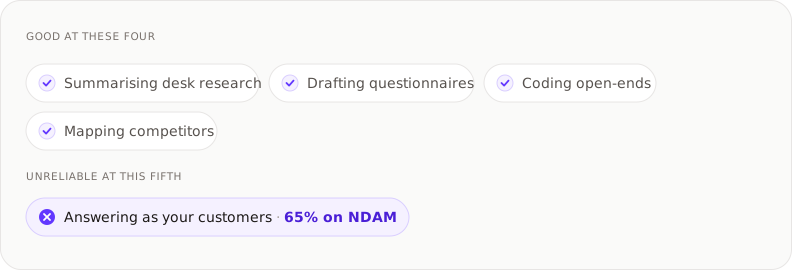
What is ChatGPT good at in market research
ChatGPT is strongest when the answer can be traced back to material already in front of it.
Summarising desk research. Give it analyst reports, internal decks and interview notes. Ask it to identify repeated objections, disagreements between sources and hypotheses worth testing. Its job is to compress and organise the evidence you supplied.
Drafting questionnaires and discussion guides. Use it for a first draft, then ask it to identify leading questions, double-barrelled questions and assumptions about behaviour. A researcher still decides what belongs in the final instrument.
Coding open-ended responses. Give it a coding frame and a batch of free-text answers. Ask it to assign a code, report confidence and separate answers that do not fit. Check a sample by hand before relying on the full batch.
Mapping a competitive set. It can suggest direct competitors, adjacent categories and alternative budget lines. Verify every company and product before the list enters a decision.
Finding questions hidden in existing research. Ask it to compare interviews, survey comments and sales notes for contradictions or missing evidence. This can help a researcher decide what to investigate next. The model is identifying a question, not answering it on the customer’s behalf.
When does ChatGPT stop being a research assistant?
The role changes when the model moves from analysing evidence to predicting people.
Ask it to summarise six customer interviews and there is a record you can inspect. Ask it what a particular customer segment would buy and there may be nothing behind the answer except patterns from its training data and cues in your prompt.
The second answer can sound just as fluent as the first. Fluency does not tell you whether the audience exists in the evidence.
This distinction matters because research is used to make choices. A neat paragraph can move a proposition, campaign or product decision even when nobody can show which customers support it.
Why do persona prompts produce stereotypes?
Ben Warner, co-founder of Electric Twin, gives a simple example. Ask a general-purpose model where a 55-year-old northern woman without a degree shops, and it might say Morrisons. Add a degree and it switches to Sainsbury’s. Add “Conservative voter” and suddenly the answer is Waitrose.
The model is assembling a plausible character from the labels in the prompt. It has no evidence that the particular audience behaves that way. Each extra demographic cue pushes the answer towards another familiar association.
That behaviour is useful when the task is to generate copy, examples or ideas. It becomes risky when the output is presented as evidence about customers.
A persona prompt can also hide variation. Thousands of people may share the same age, region, education and voting preference while disagreeing about price, brands and risk. One generated character turns that spread into a single polished stereotype.
Can a better prompt make ChatGPT representative?
A better prompt can make an answer more cautious, structured and transparent. It cannot put missing customer data into the model.
You can ask for uncertainty, counterarguments or several possible perspectives. Those instructions may produce a broader answer, but the spread still comes from the model’s learned associations. It is not a measured distribution from the audience you care about.
This is why prompting and grounding solve different problems. Prompting tells a model how to respond. Grounding gives it relevant evidence. Validation checks whether the resulting answers track reality.
What should a customer prediction be able to show?
Before treating an AI-generated answer as customer evidence, ask for four things.
Where the audience data came from. The answer should be grounded in data from the population being represented, rather than demographics typed into a prompt.
How people differ. A useful result shows the distribution of responses, including segment splits and outliers. One average answer can conceal two groups pulling in opposite directions.
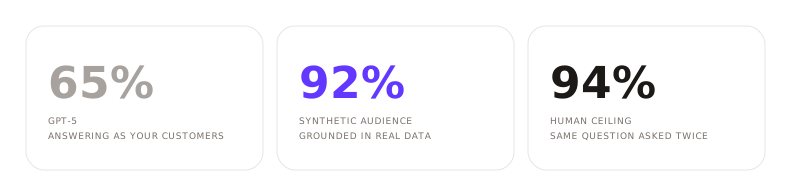
How the prediction was tested. Part of the real dataset should be held back while the audience is built. The synthetic audience then answers questions from that hidden portion, and its answers are scored against what the real people said. The evaluation questions could not have been memorised during the build.
When it was last checked. Audiences change. Periodic comparison with fresh real responses shows whether the model still represents the people behind it.
Electric Twin uses language models too. The difference is the job around the model: audiences are built from real survey data, represented individual by individual and evaluated against answers held back from the build. The accuracy methodology explains how those evaluations work.
Why does the distribution matter more than one answer?
Most decisions are affected by disagreement. A campaign may appeal to new customers and concern loyal ones. A pricing change may look acceptable overall while one valuable segment is ready to leave. An average can sit between those positions and describe nobody.
A general-purpose model tends to produce the answer that sounds most broadly plausible. That is often enough for brainstorming. Research needs to show how many people hold each view, which groups differ and where confidence is weak.
This is also why an articulate explanation is not proof. A model can give a convincing reason for an answer after generating it. The explanation becomes useful only when the underlying response is anchored to a real audience and the pattern can be checked.
For a deeper comparison of grounding, scoring and audience variation, see why generic LLMs are not synthetic audiences.
How do you keep ChatGPT useful without treating it as evidence?
Use a few practical checks.
Give it the source. Upload or paste the approved material rather than asking the model to recall facts from memory
Require traceability. Ask which document supports each conclusion and keep disagreements visible
Separate observation from inference. Make the model label what the source says, what it infers and what remains unknown
Check the work. Review a sample of classifications, citations or extracted claims before accepting a large batch
Protect sensitive data. Use only tools and environments approved for the customer, personal and confidential information involved
Match the evidence to the stakes. Brainstorming can tolerate a plausible starting point. A launch, pricing or regulated decision needs evidence that can be checked
A chat transcript should not become the evidence by itself. Keep the original sources, the method and the human review alongside the output.
Which tool fits which market research job?
Research job | Best fit | Why |
|---|---|---|
Summarising documents you already have | ChatGPT | Compresses supplied text |
Drafting a questionnaire or guide | ChatGPT, then researcher review | Produces a useful first draft |
Coding open-ended responses | ChatGPT, with sample checks | Classifies against a frame you define |
Mapping a competitive set | ChatGPT, with verification | Useful recall, unreliable precision |
Predicting how customers may respond | Grounded synthetic audience | Represents a defined audience and its variation |
Understanding which segments disagree | Grounded synthetic audience | Shows a distribution rather than one composite answer |
Producing regulated or clinical evidence | Real participants | Requires identifiable people on the record |
Testing a physical or sensory experience | Real participants | Requires a person interacting with the product |
One question sorts most cases: is the model processing evidence you supplied, or predicting people it has not been given evidence about?
Where does ChatGPT belong in the research workflow?
Start with the decision. Write down what the research needs to change and what you would do for each possible result.
Use ChatGPT to shape the work. Summarise existing evidence, draft the instrument and have the model critique its own questions.
Choose the right source of answers. Use a grounded synthetic audience for fast prediction and segmentation. Use real participants where the decision requires evidence on the record, fresh primary research or physical experience.
Read the spread. Look for segments that disagree and findings that challenge the team’s assumptions.
Follow up. Refine the question and test the surprising parts rather than accepting the first headline.
Validate periodically. Compare predictions with fresh real responses so the audience remains calibrated.
ChatGPT can help with every stage that involves organising, drafting or checking material. It should not silently become the customer sample.
Do Deep Research, Claude or Gemini change the answer?
Retrieval features improve desk research because they find sources and attach citations. Long-context models can process larger document sets. Different tools may also perform better at coding, drafting or working with particular file types.
The boundary remains the same. Access to more public material does not provide evidence about a specific customer base. A cited report can explain a category, market or published trend. It cannot reveal how your subscribers, policyholders or buyers divide on a question unless those people are represented in the underlying data.
Choose the general-purpose model that handles your material and workflow best. Judge audience prediction by the data behind it and the evaluation against reality.
Can ChatGPT replace market research?
No. It can make parts of research faster, especially synthesis, drafting and classification. It cannot replace the act of collecting or grounding evidence about a defined audience.
The useful boundary is straightforward. Let ChatGPT work on the research. Use a grounded audience or real participants when you need answers from customers.
Book a demo to see how Electric Twin builds and validates a synthetic audience from real data.