

How can a piece of software answer as your customers, and why isn’t that just making things up?
Electric Twin builds synthetic audiences: models of real-world audiences, grounded in real survey data, that companies can question and get answers from in about a minute.
That claim deserves scrutiny. A general model can produce a convincing customer opinion with no evidence that it represents your audience. Electric Twin builds the audience from real responses and tests its predictions against real answers that were kept out of the build.
What is a synthetic audience?
Audience research has always used models. When an agency runs a national poll, it surveys a sample and weights the answers so that the result better reflects the wider population.
A synthetic audience uses different technology for a related purpose. It combines real survey responses with language models to represent the range of views inside an audience. The aim is to preserve useful differences between customers instead of reducing them to one average profile.
How does a synthetic audience answer a question?
Take a real decision. Say you run a subscription and you’re weighing a £2-a-month ad-free tier. Normally you would field a survey and wait three weeks. Here is what a synthetic audience does with the same question.
First, the audience is built. We use quantitative survey responses from your audience as seed data, alongside the broader context held by language models. The audience is modelled individual by individual, keeping awkward and contradictory answers instead of blending everyone into a single “average subscriber”.
The most predictive variable is not always the most obvious demographic. If you sell breakfast cereal, whether someone eats breakfast may tell you more than their gender. The audience needs to preserve the characteristics that drive the decision, along with the uncertainty and long tails around them. That is what turns basic segmentation into useful audience discovery. How Electric Twin handles and secures customer data is set out on our trust and security page.
Then you ask. The £2 question goes to every modelled person, and each answers in character, the way that real person’s data suggests they would. This is where the difference from a general workplace assistant matters. A tool designed to help you write an email aims for one useful answer; audience research needs the full range, including minority views, uncertainty and the answers that look a bit strange.
The result does not come back as “58% would pay”. It comes back as a shape: your long-tenure subscribers mostly willing, your price-sensitive newer ones mostly not, and a middle that could go either way. The 58% average sits somewhere in that shape, describing almost nobody in it.
Then you follow up. Because answers come back in about a minute, you can read that split and ask the next question: what would make the price-sensitive group reconsider? This is also where a pretender falls over. A model that is guessing gives a fluent first answer, then contradicts itself the moment you probe. A model grounded in real data holds its ground and gives you a reason, per segment. Poke it and it stays consistent.
Then you go deeper. The same audience works in two modes. The £2 question was the structured kind, and it tells you how many. To learn why, take the price-sensitive segment into a focus group and let them talk, in the same session, off the back of the survey you just ran. You read the reasoning behind the split instead of guessing at it. The rule of thumb: run the structured version when you need to know how many, and run the conversation when you need to know why.
How is a synthetic audience validated?
Everything above would be worthless if you couldn’t check it. So the audience is built to be tested, and the test is simple enough to be hard to game.
We split your dataset in two. We build the audience from one part and hide the other part completely. Then we ask the audience the questions from the hidden part, ones it was never shown, and score how close its answers are to what those real people actually said.
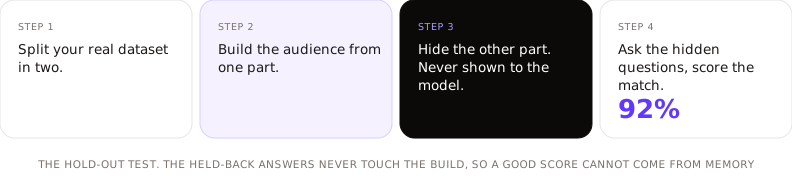
Because the held-back answers never touched the build, the audience cannot have memorised them. It either predicts them because it models the people well, or it doesn’t. There is no third option, which is exactly what makes the score mean something.
Electric Twin reports up to 96% on 1-MAE, the industry-standard measure, and up to 92% on NDAM, a stricter measure that scores the full distribution of responses. The accuracy methodology explains both measures and the benchmarks behind them.
The Times used a synthetic audience based on its 642,000-subscriber base and reserved part of its known reader panel for validation. The validated audience helped three teams run roughly ten times more research with the same headcount and budget.

Are synthetic audience results repeatable?
Run the same traditional survey twice and the result will move. You reach different people, and even the same person may answer differently depending on context, attention or what happened that morning. That variation is part of real research.
A synthetic audience adds something different: repeatability. Run the same question against the same audience under the same conditions and you can reproduce the result. That makes it useful as a controlled environment for comparing messages, testing early product concepts or exploring scenarios, and for asking the follow-up question you only thought of after seeing the first answer.
Repeatability still needs regular checks against reality. Audiences change, so fresh survey responses and periodic validation are needed to confirm that the model still represents the customers it was built to reflect.
Why does accuracy stop short of 100%?
People do not answer every question consistently. On NDAM, human test-retest research sets a realistic benchmark of about 94%. Electric Twin reports up to 92% on the same measure.
An off-the-shelf GPT-5 model answering directly scores 65% on NDAM in the same comparison. The full accuracy explanation covers the methodology, results, and limits in more detail.
When should you use real respondents?
Audiences with too little real data. Accuracy depends on the depth of evidence behind the model. Run primary research first when the available survey data is too thin.
Work that needs identifiable people on the record. Regulated claims, clinical studies, and legally mandated testing require real respondents.
Physical and sensory questions. Taste, touch, packaging use, and other physical responses need real-world testing.
Ongoing audience checks. Fresh surveys are needed periodically to confirm that the synthetic audience still reflects the customers it represents. The relationship is explained in synthetic versus traditional research.
The whole process on one page
Synthetic audiences make it practical to test questions that may not justify a separate research project: a subject line, a product name, one pricing tier, or a small customer segment. Teams can test these decisions while there is still time to change them.
The four stages, in brief:
Stage | What goes in | What comes out | How you check it |
|---|---|---|---|
1 · Build | Your real survey or first-party data | An audience modelled individual by individual, outliers kept | Every answer is rooted in your real responses |
2 · Test | Part of the dataset held back and hidden | A score against answers the model never saw | Two published measures: 1-MAE and NDAM |
3 · Ask | A question in plain language: survey, group, message test or image test | Answers in about a minute, broken out by segment | Ask a follow-up and check whether the reasoning stays consistent |
4 · Read | The results of your questions | Summaries, interactive graphs and downloadable slides | Read the spread and where segments disagree |
Frequently asked questions
How long does it take to build an audience?
The gate is data, not compute. If you already hold usable survey or first-party data about the people you want to model, building and validating the audience is quick. If you don’t, sourcing the right data is the part that takes time, and we can help with that.
How often should a synthetic audience be revalidated?
Revalidate it periodically against fresh survey responses. Customer attitudes and behaviour change, and new validation shows whether the audience still reflects the people it represents.
Are synthetic audiences the same as AI personas?
No. A persona prompt asks a general model to act a part, with nothing to score it against. Workplace assistants are designed to return a coherent, helpful answer, which makes them prone to collapsing an audience into a stereotype. Research needs the awkward answers, the minority groups and the long tails too.
A synthetic audience is built from real seed data about real people, designed to preserve the distribution of views, and validated against held-out real answers. We go deeper in why generic LLMs aren’t synthetic audiences and explain the distinction between synthetic respondents, personas and panels.
Want to test one of your own research questions? Book a demo.

